Enjoying beautiful sunset on Boko Temple

sunset boko temple

Grandeur of the buildings of archaeological sites with high-value architecture widely available in Sleman, Yogyakarta. One of them, the site Kraton Ratu Boko, located in the south of Prambanan temple. Besides interesting in terms of architecture, the other attraction is the beauty of the sunset, landscape, and panoramic beauty of nature.

To enjoy the sunset, you have to get on the site Ratu Boko, before 16:00 pm, when the weather is sunny. Point to enjoy the most beautiful sunset is at the gates of Ratu Boko site. You can take a position on the steps of the gate, in the middle of the gate, or in the upper court after the entry gate. From this location can be seen clearly that the yellow sun like a ball slowly down to earth. Looks beautiful golden light surrounding it, and the fluoresce to the sky.

If you are in courtyard after the entrance gate, you will see the yellow ball is in the site gates. Although the sunset only lasts a few minutes, but its beauty will make a special experience for you, of course, that will not be forgotten. Besides taking up positions around the gate, you can also enjoy the sunset on Pembakaran Temple, the highest point of Ratu Boko temple.

The position of the site at the top of the limestone hills, you can enjoy the natural scenery is very beautiful. Expanse of farmland looked like tapestry stretched wide under the hills. If your view is directed to the north, seem magnificence Prambanan and Sewu. When the weather is sunny, you can see Mount Merapi, which became the background of Prambanan Temple.

For those of you who like tracking, Ratu Boko be the right choice. You can navigate not only Ratu Boko temple complex, but also the surrounding complex of temples, including Candi Ijo, Banyunibo and Barong.
Written by: Jogja Holidays
Jogja Holidays, Updated at: 9:42 PM

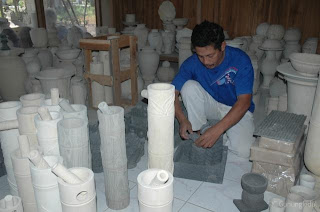
Mojo Tourism Village, white stone ornament craft center

Mojo Tourism Village

Mojo Tourism Village, located in the village Ngeposari, Semanu, Gunungkidul, Yogyakarta, 7 km eastward city Wonosari. Mojo Tourism Village is the center of the white stone ornament craft. This location is easily accessible by paved roads smooth, and refreshing atmosphere of the countryside. Some products such as handicrafts, ashtrays, flower vases, decorative lights, garden supplies, and home building ornaments in a variety of shapes and sizes.

Jlamprong Cave

In the Mojo Tourism Village, there is also a Jlamprong Cave, the cave is horizontal with a length of 700 meters with beautiful stalactites and stalagmites.The cave has three mouth of the cave and the four pillars or pillar of the buffer, which is sacred citizens. The third entrance to the cave is the Cave Gesing, Jlamprong Cave and Cave Sinden.
Written by: Jogja Holidays
Jogja Holidays, Updated at: 9:48 PM

Megalithic Sites Sokoliman

Megalithic Sites Sokoliman

Located in the hamlet Sokoliman, Bejiharjo Village, District Karangmojo. The site is formed in the prehistoric period, a menhir, menhir fragments, and stone walls of the tomb. In 1934, Jl Moens and Van der Hoop conduct research on site Sokoliman, find the grave in the form of stock beads, iron tools, fragments of pottery and bronze objects.

In 1989, BP3 (Heritage Preservation Hall) Province Yogyakarta to make corrections, collect menhirs scattered, and the public about these megalithic relics called by the name of "Kuburan Budho". In the past megalithic, menhir is a manifestation of community leaders who have passed away, but it also serves as a medium of worship of ancestral spirits. Sokoliman megalithic cultures have distinctive, especially on menhirnya, which is at the top, carved human faces.

Written by: Jogja Holidays
Jogja Holidays, Updated at: 11:06 PM

Maria Tritis cave, where Christians make pilgrimages

Maria Tritis cave

Maria Tritis cave is one of the natural cave that is in a row of Gunungkidul karst hills and used as a place of pilgrimage Catholics. Named Tritis because there is always water dripping (Tumaritis) of stalactites in the cave ceiling. At first this cave is a place of quiet and eerie so not many people who dare to enter. Therefore, this cave is often used as a hermitage and a haven some prince of the kingdom of Mataram. The cave became known by Catholics in 1974, which at the time used as a Christmas Eucharist. From that moment Gua Tritis given an additional name Mary, and became a favorite of pilgrims.

To reach the cave, the pilgrims have to walk through the fields teak, There are two options to reach the location of the Cave of Mary Tritis, which is about 1.5 km long route and short route as far as 500 meters. Pilgrims who did "the cross of roads" is usually a long pass route, with 14 stations dismissal, which comes diorama the passion of Jesus. At 12 stations to be built 3 cross pieces under the hill, depicting the crucifixion of Jesus with 2 people criminals.

When May and October, Gua Maria Tritis pilgrims crowded, because of the months is the month of Mary. As for pilgrims who want to follow the Novena prayer in the cave could come in the first week of each month.
Written by: Jogja Holidays
Jogja Holidays, Updated at: 10:54 PM

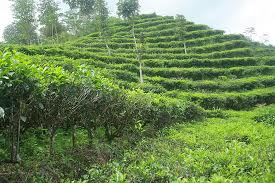
Nglinggo Tourism Village, natural panorama of tea plantation

Nglinggo Tourism Village

Nglinggo Tourism Village, located in the village Pagerharjo, Samigalwuh District, Kulon Progo Regency, and was in Menoreh Mountains. The appeal of this is a tourist village, mountainous landscape, tourist trekking, waterfalls, rustic feel, tea and coffee plantations.

The villagers mostly work as farmers and goat herders. Farming and husbandry activities is an interesting activity. In addition, green tea plantations that stretches wide, and the feel of rural Java, with ancient houses (Joglo, villages, and pyramid) are still well preserved, making the village look beautiful and natural. Moreover, coupled with Menoreh cool mountain air.

Nglinggo communities still maintain the tradition of Javanese life and traditional art in everyday life. The visitors can stay with a family in a country house, including engaging in activities tapping palm sugar, picking tea, coffee, and the milking etawa goat.

With special packages, visitors can also learn and see the show Jathilan and Lengger Tapeng, typical of Hamlet Nglinggo.

In Nglinggo Tourism Village, there is a waterfall Grojogan Watu Jonggol. The beauty of the waterfall above an altitude of 900 meters above sea level, with a typical cool mountain air with green plants and trees that are so captivating.
Written by: Jogja Holidays
Jogja Holidays, Updated at: 9:40 PM

Geospatial Laboratory and Museum of Natural Sand Dunes

Geospatial Laboratory, Museum of Natural Sand Dunes

Geospatial Laboratory is a coastal research center managed by the Geospatial Information Agency, in collaboration with the Faculty of Geography and Bantul regency government. One part of it is the Museum of Natural Sand Dunes. Complex Geospatial Laboratory located in the sand dunes, not far from Depok Beach, Parangtritis village, Bantul regency. The main building pyramid architecture.

The three main building of the Geospatial Laboratory describes the process of sand dune. The main building of the pyramid depict volcanoes, which produce sand during eruption. Sand from the volcano flowed into the sea via rivers Opaque, illustrated by building a knowledge corridor. While the sand, rocks, and coral reefs, is the material contained in the sand dunes, which stretches along the coastline Parangtritis. Sand is carried into the sea slammed back to shore by the waves of the sea, and when dry, blown by strong southeasterly winds, forming sand dunes.

Geospatial Laboratory opened for 24 hours. While the office opening hours from 08.00 am - 16.00 pm. For researchers or tourists who stay overnight, dormitory available to travelers which can accommodate 80 people. In addition to learning about the sand dunes, visitors can also enjoy a variety of events related to the beach and coastal regions and in different parts of the world through a video that is in the meeting room.
Written by: Jogja Holidays
Jogja Holidays, Updated at: 10:22 PM